Scope and priorities
Share the date, venue, audience, programme and budget range. Identify the decisions already made and the areas requiring recommendations.
Turn your event brief into a workable production plan. Point Expo coordinates the design, technical services and delivery stages agreed for your conference, seminar, convention or launch.
Discuss your project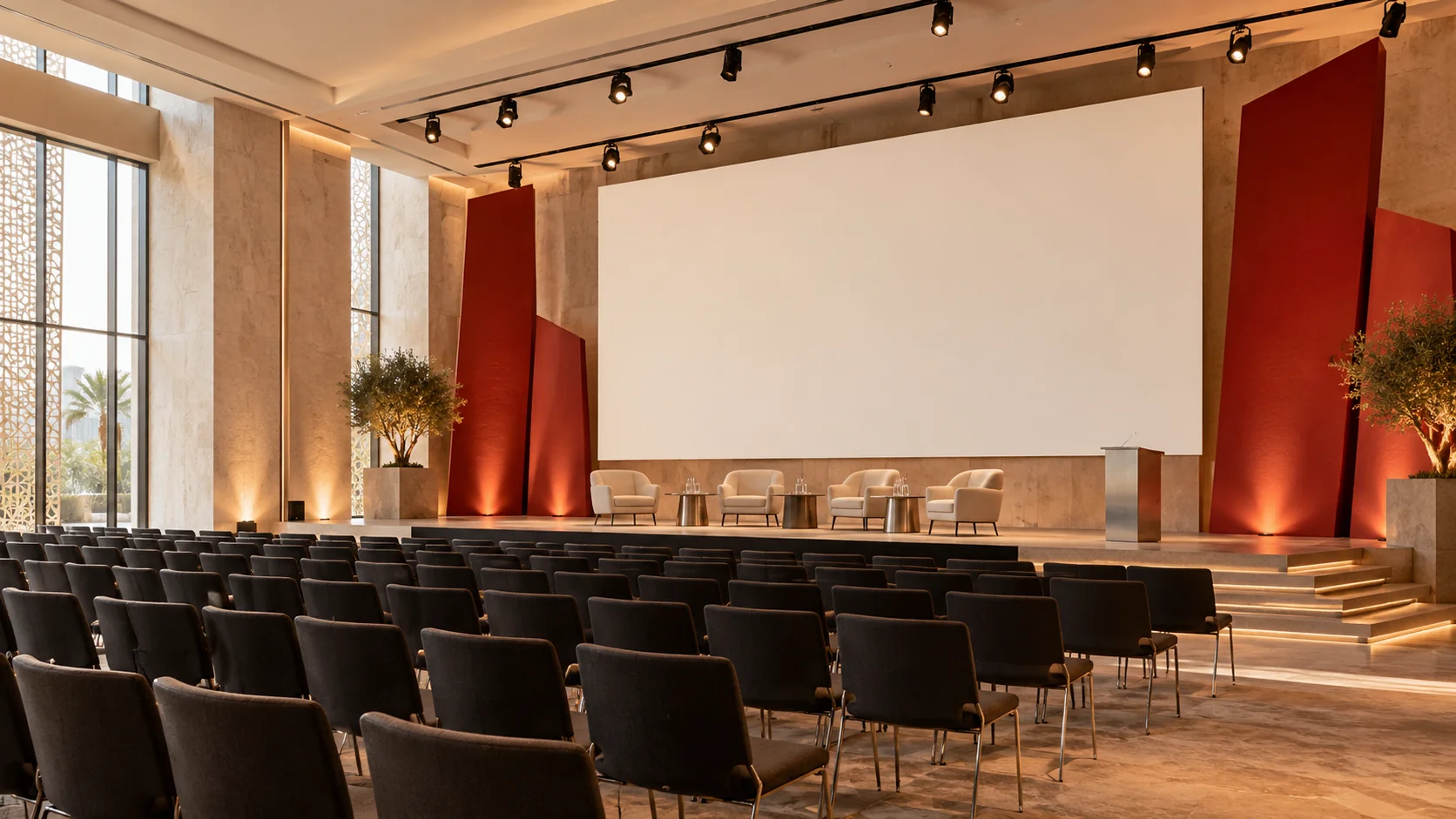
Event management starts by connecting the audience, venue and running order. We review the objectives, guest profile, spaces, speakers and technical needs to identify the work involved. The scope may cover scenography, stage and seating layouts, signage, audiovisual coordination and installation supervision.
Choose full project coordination or support for specific production elements, subject to the project assessment. The quotation should identify deliverables and exclusions, including whether equipment operation, transport, rehearsals, live support and removal are included. Your team retains a clear view of the decisions it needs to approve.
A conference requires more than a sequence of slide presentations. Speakers need arrival and rehearsal instructions; technicians need content formats and cue points; reception teams need an attendance and wayfinding plan. We bring these requirements into a shared schedule so that each supplier can prepare against the same information.
For launches and networking events, the balance is different: demonstrations, guest circulation and informal conversations may take priority. Review our professional event formats to clarify which experience best fits your objective.
Room dimensions, ceiling height, existing power, acoustics and screen sightlines guide equipment choices. The production plan should also establish loading access, permitted setup periods, storage, cable routes and emergency access. Venue rules must be confirmed with its management; an attractive layout alone does not establish feasibility.
Our event equipment services can be assessed as part of the same brief. Where an exhibition space is involved, coordinate the stand footprint and technical connections with the wider event layout.
Share the date, venue, audience, programme and budget range. Identify the decisions already made and the areas requiring recommendations.
Review the layout, technical requirements and service boundaries. Agree the approval contacts and deadlines before suppliers prepare their work.
Consolidate supplier instructions, content delivery, installation slots and testing requirements. Resolve dependencies before the event opens.
Follow the agreed running order and coordination scope, including setup, live adjustments and the planned removal of equipment.
Guest count, room configuration, installation time, equipment, custom production and staffing all affect the budget. Separate essential requirements from optional enhancements and clarify which venue services are already included. This makes competing proposals easier to assess on an equivalent basis.
A provisional brief is useful even when some details remain open. Flag those uncertainties explicitly so that assumptions can be reviewed before booking or production.
Share the contacts, agreements and services already booked. The coordination scope can then identify remaining requirements and interfaces without duplicating existing responsibilities.
The quotation defines the services included. Venue hire, catering, travel, permissions and other third-party costs should be checked explicitly rather than assumed to be part of the production fee.
Send it as soon as the date and format are taking shape. Required lead time depends on availability, venue approvals, technical complexity and any custom production.
Explore our expertise and practical information to prepare your project in each city.